

How to Make Simple Motion Graphics with AI: A Complete Beginner's Guide
By Malloy Studio - Published April 11, 2026
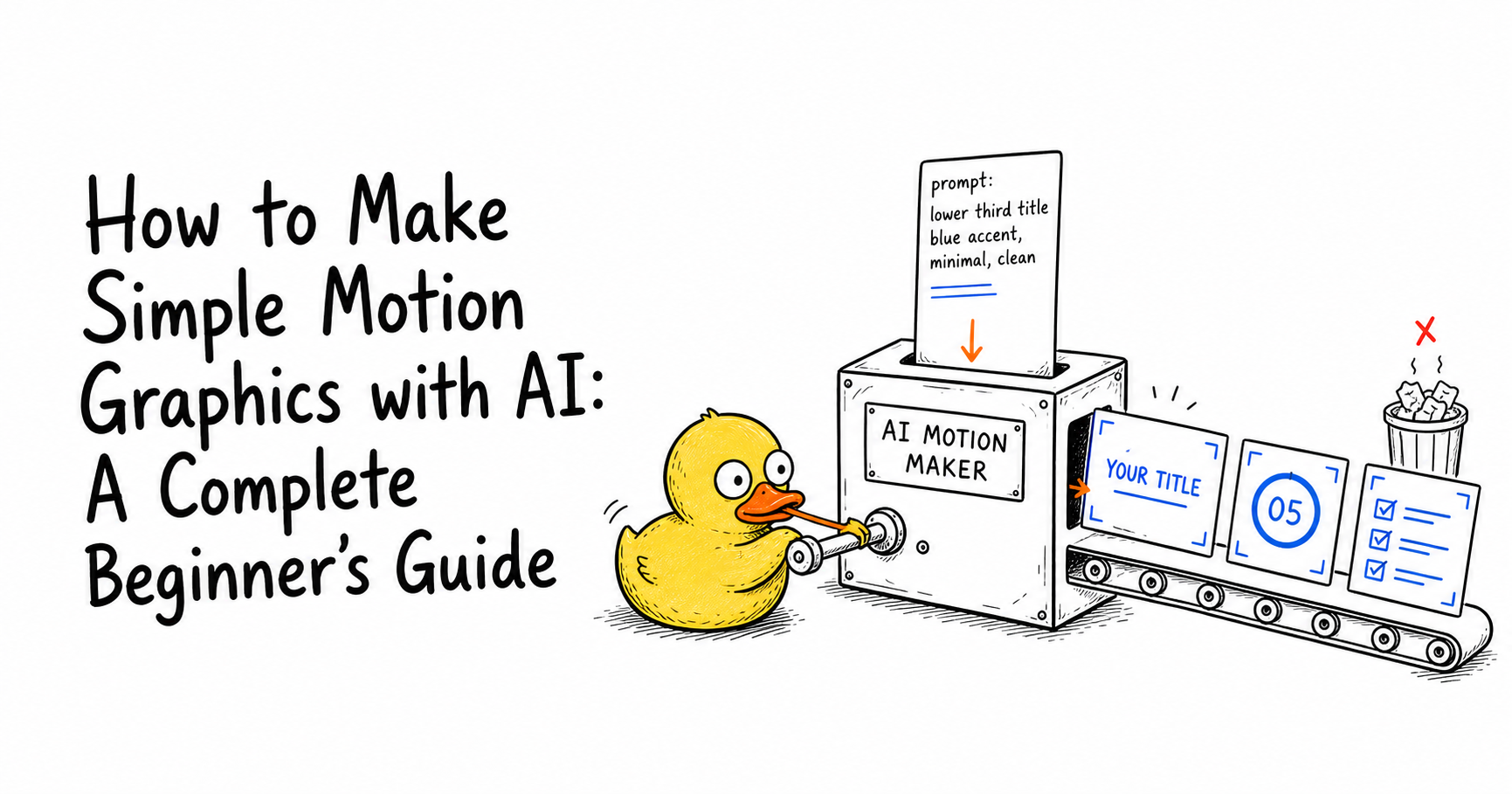
You have seen those clean animated titles, counters, and data visualisations in YouTube videos and social content. You know they would make your own videos look more professional. But every time you have tried to figure out how to make them, you hit the same wall: After Effects tutorials that assume you already know After Effects.
The good news is that in 2026, you can make simple motion graphics with AI. No software to learn. No templates to wrestle with. No keyframes, no timelines, no masking. You describe what you want, and the AI generates it.
This guide walks you through everything a complete beginner needs to know to start making AI motion graphics today. For the full product category breakdown, read the AI motion graphics generator guide first.
Quick Answer
You can make simple motion graphics with AI by describing the animation you want in plain language, generating a first draft, then adjusting text, colors, timing, layout, and export format. Start with one clear job: an animated title, lower third, stat counter, chart, callout, list reveal, logo animation, or transparent overlay. A beginner-friendly prompt should include the words that appear on screen, the visual structure, the motion style, the color direction, the aspect ratio, and whether the background should be transparent. You do not need After Effects knowledge, templates, keyframes, masking, or animation terminology. AI is strongest when the graphic communicates one idea clearly and stays readable on mobile. After generation, refine only what matters for the edit: wording, scale, spacing, timing, and brand fit. Then export the asset and place it above your footage in your video editor.
What Are Motion Graphics, Really?
Motion graphics are animated visual elements. They are not full cartoons or character animations. They are the practical, information-driven graphics that make videos easier to follow and more engaging to watch.
Common examples of simple motion graphics include:
| Motion graphic | What it does |
|---|---|
| Animated titles | Slide, fade, or type onto the screen. |
| Lower thirds | Introduce a speaker's name and role. |
| Data visualisations | Animate bar charts, line graphs, counters, and other data moments. |
| Callouts | Highlight or annotate something on screen. |
| List reveals | Show bullet points one at a time. |
| Stat counters | Tick up from zero to a final number. |
| Logo animations | Bring a brand mark to life. |
These are the motion graphics that make up 90% of what creators, marketers, and businesses actually need. They are not complex. They do not require artistic talent. They just require the right tool.
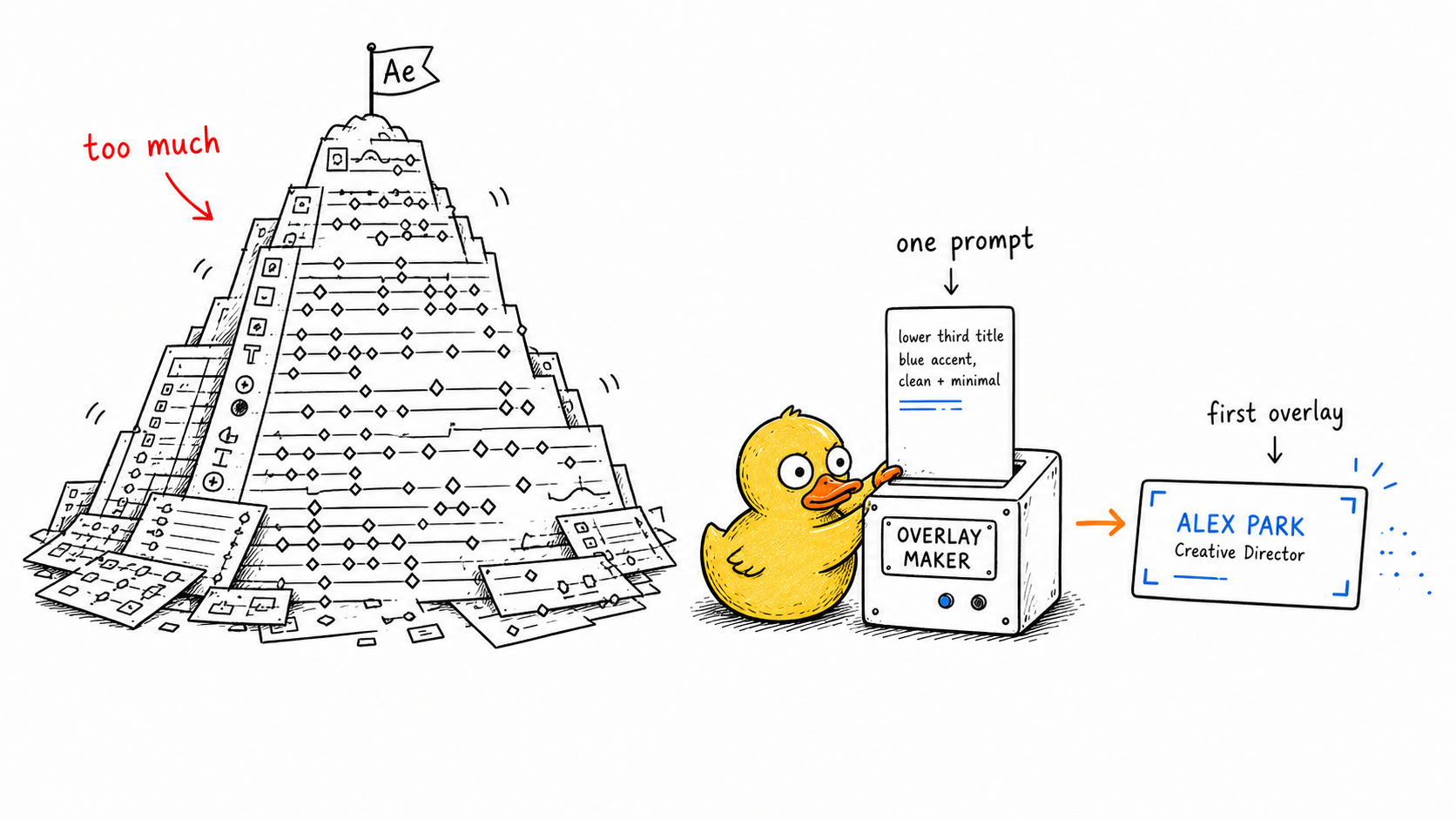
Why Do Most People Never Make Motion Graphics?
Traditionally, making even simple motion graphics required one of two paths:
| Path | What it involves | Why it blocks beginners |
|---|---|---|
| Learn professional software | After Effects, Apple Motion, or similar tools. | Powerful, but the learning curve is measured in months, not hours. |
| Use templates | Pre-made motion graphics templates from marketplaces like Envato. | Generic, hard to customise, and often still require After Effects to modify. |
Both paths have the same fundamental problem: the effort required to make a simple motion graphic is wildly disproportionate to the simplicity of the end result. A "Revenue: $2.4M" counter animation should not take an afternoon to create.
This is exactly what AI motion graphics have solved.
If After Effects is the specific blocker, the no-After-Effects workflow shows how to move from prompt to editor overlay.
How AI Motion Graphics Work
AI motion graphics tools let you create animations by describing what you want in plain text. Instead of manually placing shapes, setting keyframes, and adjusting timing curves, you write a prompt.
Here is what the process looks like:
-
You write a prompt. For example: "An animated bar chart showing Q1, Q2, Q3, Q4 revenue with bars growing upward. Blue colour scheme, clean minimal style, transparent background."
-
The AI generates the animation. Within seconds, you get a fully animated motion graphic that matches your description. The AI handles layout, timing, easing, and visual design.
-
You refine if needed. Adjust text, colours, timing, or layout using simple controls. No keyframe editing. No timeline scrubbing.
-
You export. Download as a transparent video file that you can layer over your footage in any video editor.
That is it. A motion graphic that would take hours in After Effects takes minutes with AI. And the quality is professional because the AI has been trained on established motion design principles.
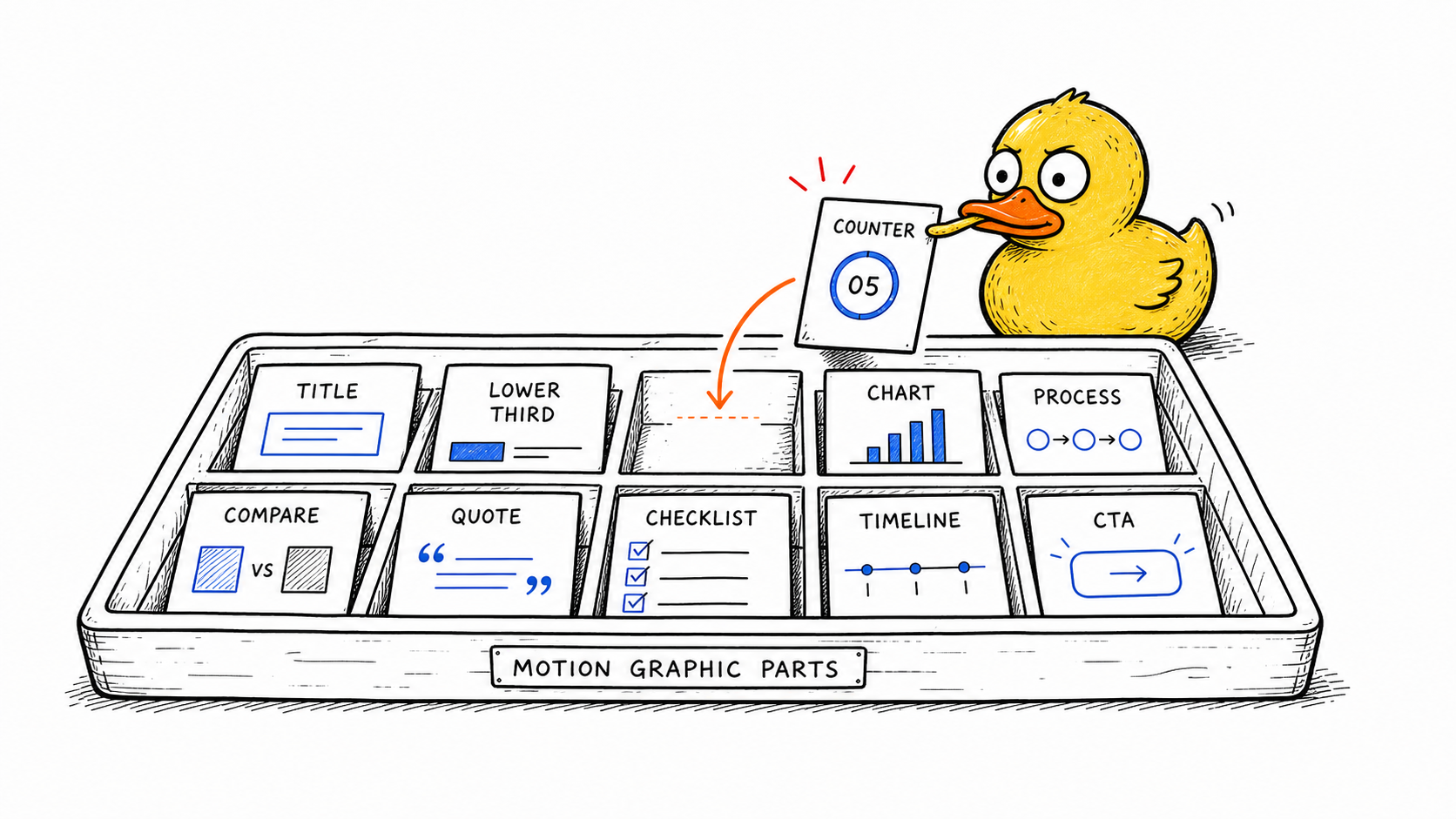
10 Simple Motion Graphics Any Beginner Can Make with AI
Here are the most useful motion graphics you can start making right now, with example prompts to get you started.
| Motion graphic | What it does | What to prompt | Where to use it |
|---|---|---|---|
| Animated titles | Immediately makes your video look more produced. | "Title text that reads 'The Future of Remote Work' with a clean fade-in and subtle scale animation. White text on transparent background, modern sans-serif font." | Video intros, section headers, YouTube thumbnails brought to life. |
| Lower thirds | Shows the name and title card in the bottom third of the screen. | "Lower third with name 'Sarah Chen' and title 'Head of Product' that slides in from the left with a subtle accent line. Clean professional style, transparent background." | Interview content, podcasts, team introduction videos, event recordings. |
| Stat counters | Creates anticipation and makes data feel dynamic. | "Animated counter that counts up from 0 to 12,847 with the label 'Active Users' underneath. Bold number, clean layout, transparent background." | Company updates, pitch videos, case studies, social proof content. |
| Bar charts | Makes chart data more memorable than a static screenshot. | "Horizontal bar chart comparing five marketing channels by ROI. Bars animate in from left to right, staggered. Labels on each bar. Clean dark colour scheme, transparent background." | Data-driven content, quarterly reports, educational explainers, ad creative. |
| Process flows | Makes each step of a process clear and memorable. | "Three-step process flow with icons: Step 1 'Upload', Step 2 'Edit', Step 3 'Publish'. Each step fades in left to right with connecting arrows. Minimal style, transparent background." | Product demos, onboarding videos, educational content, how-to guides. |
| Comparison graphics | Draws attention to differences and makes your argument visual. | "Split comparison graphic with 'Before' on the left and 'After' on the right. Dividing line wipes from top to bottom. Clean layout with green accent for 'After', transparent background." | Case studies, product marketing, transformation content, testimonials. |
| Quote animations | Makes testimonials feel more polished than simple text overlays. | "Animated quote that reads 'This saved our team 20 hours per week' with quotation marks that fade in first, then the text types in. Attribution 'James R., Marketing Director' fades in below. Elegant style, transparent background." | Testimonial content, social proof, LinkedIn posts, ad creative. |
| Checklist reveals | Creates visual rhythm as each item appears with a checkmark. | "Animated checklist with four items: 'Brand Kit', 'Content Calendar', 'Analytics Setup', 'Team Training'. Each item slides in with a green checkmark. Clean layout, transparent background." | Educational content, onboarding videos, how-to guides, product feature lists. |
| Timeline animations | Builds progress, history, or roadmap moments step by step. | "Vertical timeline with four milestones: '2023 Founded', '2024 First 1K Users', '2025 Series A', '2026 Global Launch'. Each node appears sequentially with a connecting line that draws between them. Clean minimal style, transparent background." | Company story videos, pitch decks, milestone content, year-in-review. |
| Call-to-action animations | Makes the final action more noticeable than a static text card. | "Animated CTA card with text 'Start Your Free Trial' and a button that pulses with a subtle glow effect. Clean modern design, brand blue colour, transparent background." | Video outros, ad endings, product launch videos, demo conclusions. |
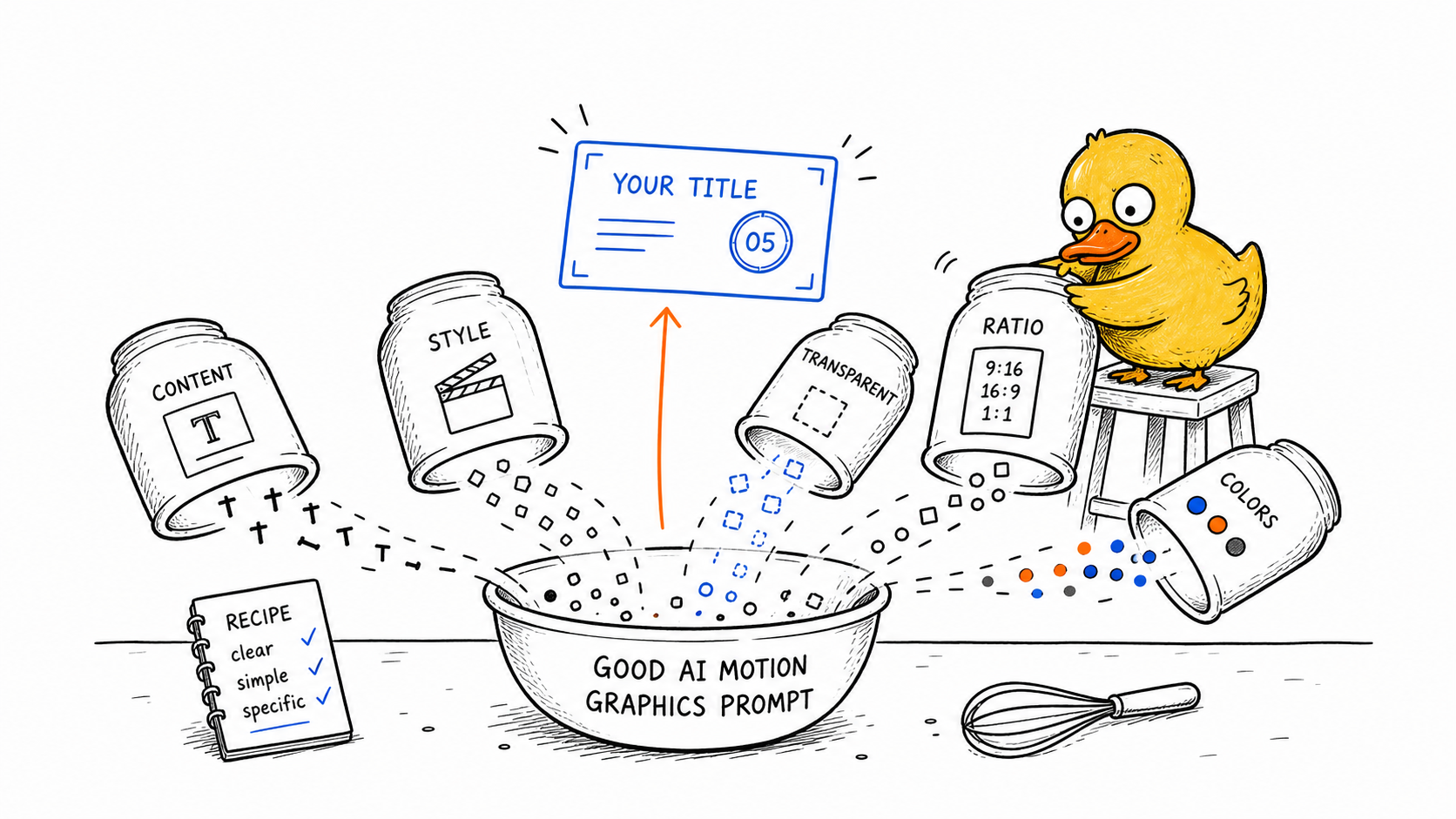
Tips for Writing Better AI Motion Graphics Prompts
The quality of your AI motion graphics depends heavily on how you describe what you want. Here are practical tips for getting better results.
Be Specific About Content
Bad prompt: "Make a chart"
Good prompt: "Animated pie chart showing market share: Product A 45%, Product B 30%, Product C 25%. Each segment animates in clockwise. Labels on each segment."
The more specific you are about what text, numbers, and labels appear, the less refining you need to do afterwards.
Describe the Animation Style
AI motion graphics tools can produce many different animation styles. Tell the AI what you want:
| Style phrase | Best for |
|---|---|
| "Clean and minimal" | Corporate and professional content |
| "Bold and dynamic" | Energetic social media content |
| "Elegant and subtle" | Premium brand content |
| "Playful and colourful" | Casual or youth-oriented content |
Always Specify Transparent Background
If you plan to overlay your motion graphic on video footage, include "transparent background" in your prompt. This gives you a video file with an alpha channel that layers cleanly over anything.
Include Colour Preferences
Mention your brand colours or at least a colour direction. "Blue and white colour scheme" or "Use brand colour #FF6B35 as the accent" keeps your motion graphics visually consistent.
Mention Aspect Ratio When It Matters
If you are creating for a specific platform, specify the format:
| Aspect ratio | Use it for |
|---|---|
| 16:9 | YouTube and horizontal video |
| 9:16 | TikTok, Instagram Reels, and YouTube Shorts |
| 1:1 | LinkedIn and Instagram feed posts |
Where Can You Make Simple Motion Graphics with AI?
Malloy Studio is built specifically for creating motion graphics from text prompts. You describe what you want, and it generates a professional animation in seconds. No design experience required, no software to install.
The workflow is simple:
- Open Malloy Studio
- Describe your motion graphic in the prompt field
- Generate and preview the result
- Adjust text, colours, or layout if needed
- Export as a transparent video file
- Layer it over your footage in any video editor
You can create titles, data visualisations, lower thirds, callouts, counters, and more. The output is production-ready and exports with a transparent background so you can add it to any video.
Adding AI Motion Graphics to Your Video Editor
Once you have exported your motion graphic, adding it to your video is straightforward regardless of which editor you use.
| Editor | How to add the motion graphic |
|---|---|
| Premiere Pro | Import the file into your project, then drag it onto a video track above your main footage. |
| DaVinci Resolve | Import it into the media pool and drag it to a track above your main timeline. |
| Final Cut Pro | Import it and place it on a connected storyline above your primary footage. |
| CapCut | Import it as an overlay, including on mobile when the transparent file format is supported. |
The key point is that AI motion graphics export as standard video files. They work with any editor, no plugins or special setup required.
Common Mistakes Beginners Make
Overcomplicating Prompts
You do not need to describe every frame of the animation. Focus on what appears, how it is arranged, and the general style. Let the AI handle the specifics of timing and easing. Simple prompts like "animated bar chart with three bars growing upward, clean style, transparent background" produce clean results.
Using Too Many Motion Graphics
More is not always better. A video with a motion graphic every five seconds becomes visually exhausting. Use motion graphics at key moments: the intro, important data points, transitions between sections, and the outro. Give your viewers visual breathing room.
Ignoring Brand Consistency
If every motion graphic in your video uses a different colour palette and style, the result looks scattered. Pick a consistent style and colour scheme and use it across all your motion graphics. Include these details in every prompt.
Forgetting About Mobile Viewers
Most social media content is consumed on phones. Make sure your text is large enough to read on a small screen. What looks fine on your desktop monitor might be unreadable on a phone. When in doubt, make text bigger than you think it needs to be.
FAQ
Can beginners make motion graphics with AI?
Yes. Beginners can make motion graphics with AI because they do not need to build keyframes, layers, or animation timelines from scratch. They can describe the result they want in plain language and refine the generated animation.
The main skill is not animation software. It is clarity: knowing what you want to show and writing a specific prompt.
What are the easiest motion graphics to make first?
The easiest motion graphics to make first are animated titles, lower thirds, number counters, checklist reveals, simple bar charts, and callouts. These formats are focused, readable, and easy to describe in a prompt.
Start with one idea per animation. Simple motion graphics usually look better than overcomplicated ones, especially when you are learning.
Do I need After Effects to make simple motion graphics?
No. You do not need After Effects to make simple motion graphics if you use an AI motion graphics tool. AI tools can generate common formats like titles, charts, counters, and overlays without manual animation work.
After Effects is still useful for advanced custom animation, but it is not required for most beginner motion graphics.
How do I add AI motion graphics to my video editor?
Export the AI motion graphic as a video file with a transparent background, then place it on a video track above your footage. The transparent areas show through, so the motion graphic behaves like an overlay.
This workflow works in editors such as Premiere Pro, DaVinci Resolve, Final Cut Pro, and CapCut when the exported file format supports transparency.
What makes beginner motion graphics look professional?
Beginner motion graphics look professional when they are clear, readable, and consistent. Use large text, simple layouts, intentional colors, and smooth timing that supports the video instead of distracting from it.
The goal is not to animate everything. The goal is to make important information easier to notice and understand.
Related articles
Keep reading
June 16, 2026
What to Prompt for AI Motion Graphics When You Do Not Know Where to Start
Stuck staring at a blank AI motion graphics prompt? Learn how Malloy Studio helps you start from templates, remix existing layouts, and use image references.
June 8, 2026
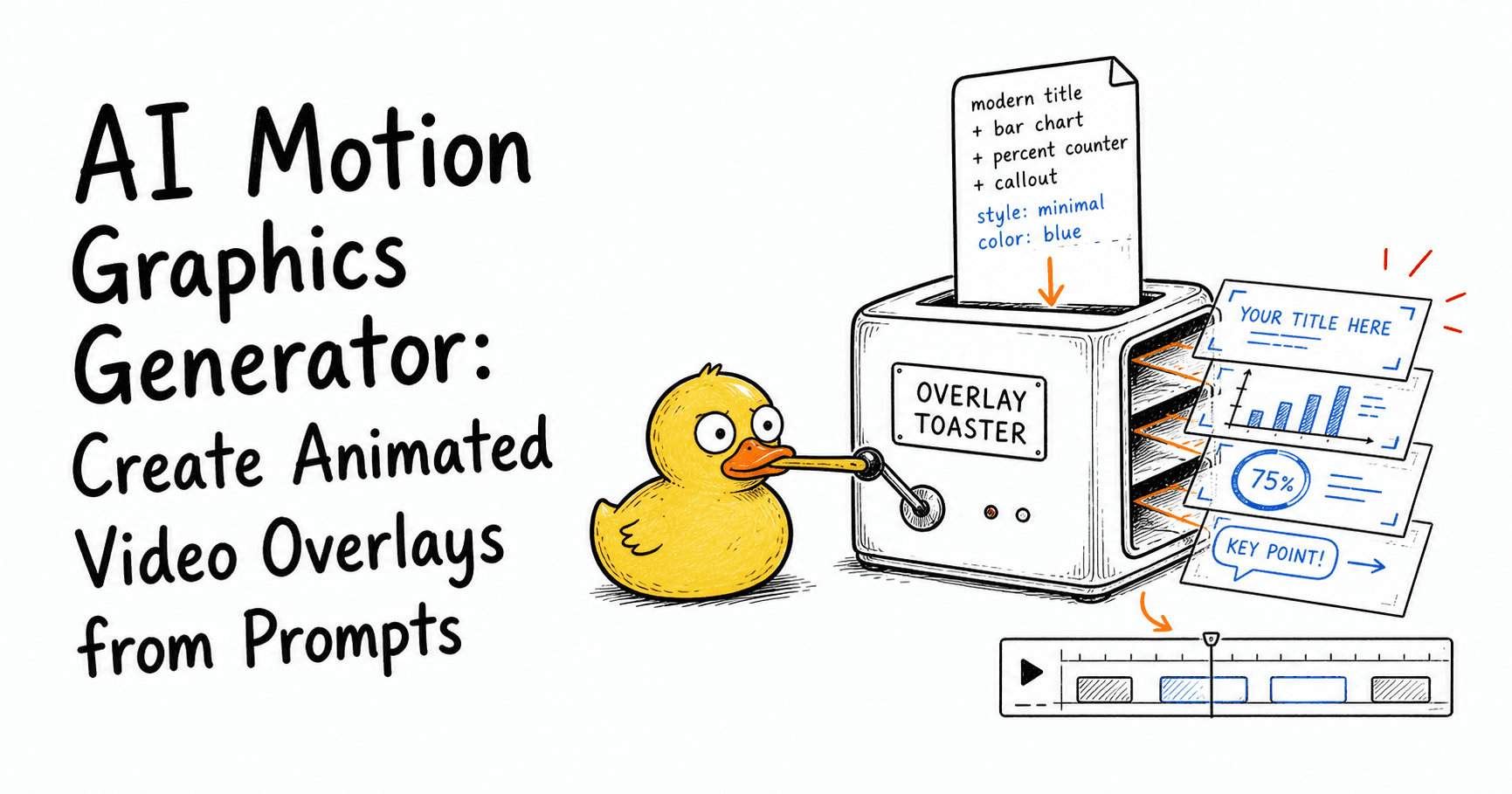
AI Motion Graphics Generator: Create Animated Video Overlays from Prompts
Learn what an AI motion graphics generator is, how it works, what to use it for, and how to create animated titles, charts, callouts, counters, and overlays from prompts.

April 9, 2026
How to Add AI Motion Graphics to Your Videos Without After Effects
Learn how to add professional AI motion graphics to your videos in minutes. No After Effects, no templates, no design skills. Just describe what you need.
From Zero to Professional-Looking Videos
The gap between amateur and professional-looking video is smaller than most people think. It is rarely about camera quality or lighting. It is about the details: clean titles, data that is visualised instead of just spoken, transitions that are smooth, and information that is reinforced visually.
Motion graphics are the single biggest contributor to that professional feel. And with AI, making simple motion graphics is now as easy as typing a sentence.
You do not need to become a motion designer. You do not need to learn After Effects. You do not need to spend hours watching tutorials. You need a clear idea of what you want to show and the ability to describe it in a few words.
Try Malloy Studio and make your first AI motion graphic in under a minute.